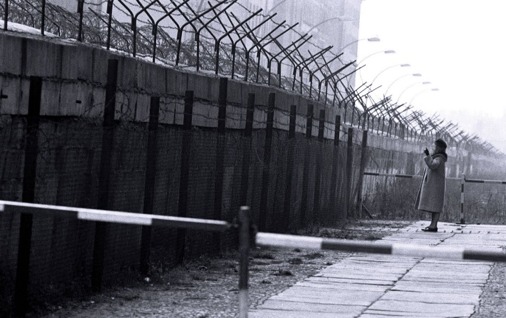
On January 5th, fellow club member Thomas Reppchen shared the story of his life in East Germany and his escape to West Germany during the Soviet regime at the age of 19.
Thomas was born in Leipzig. His mother was from Germany and his Father from Cambodia. They met when his father was on a foreign student exchange in Leipzig. Both families experienced very difficult times as a result of politics and the respective governments in those countries. Most of his father's family was killed by the Khmer Rouge while Pol Pot held power from 1975 to 1979 - except for his father and uncle who were studying abroad at the time.
Thomas' family was split up in 1949 when West and East Germany were formed. The hotel that his grandmother owned and managed in Leipzig was seized by the Soviets. There were severe restrictions on cross border movement, including the construction of the Berlin Wall, which led to many East Germans being shot as they attempted to escape from East Germany.
While in Grade 4, Thomas asked to sign up for 12 years of military service. His mother put an end to that possibility by immediately transferring him to another school. In his teens, he did end up completing several years of military service, but was able to focus his training in the area of trucks, trailers, and motorcycles. Thereafter, his education took a path down the road to a career in hospitality, following in his grandmother's footsteps.
During his student years, he became involved in politics, and, not surprisingly, he and his family came under government surveillance because 1 in 3 East German citizens at the time were working for the Stasi intelligence agency. After a weekly demonstration for press freedom resulted in peaceful protesters being shot, Thomas and his friend Frank hatched a plan to escape to Prague. At the last minute they decided to cross into West Germany instead, with the intention of joining Thomas's relatives in northern Germany.
The harrowing journey was carried out in a Trabant car during a heavy rainstorm. When they arrived at the border crossing, the border guard (armed with a machine gun) asked if they were immigrants, giving an indication that this was the best option for response. After a tense moment, they replied affirmatively, and were allowed to entered West Germany.
Following extensive interrogation at the refugee camp, Thomas was able to journey on to join his uncle and aunt and watch as the Berlin Wall began to come down. On November 9th, 1989, the Communist Party announced that citizens of East Germany were free to cross the country’s borders.
Thomas concluded by saying that a lot of people in East Germany died fighting for free speech, something we can take for granted in Canada. However, his experience is that democracy and freedom of speech are very fragile. Thank you to Thomas for sharing his personal story and first-hand experience with a monumental time in recent history.
A Personal and Professional Perspective on Reconciliation
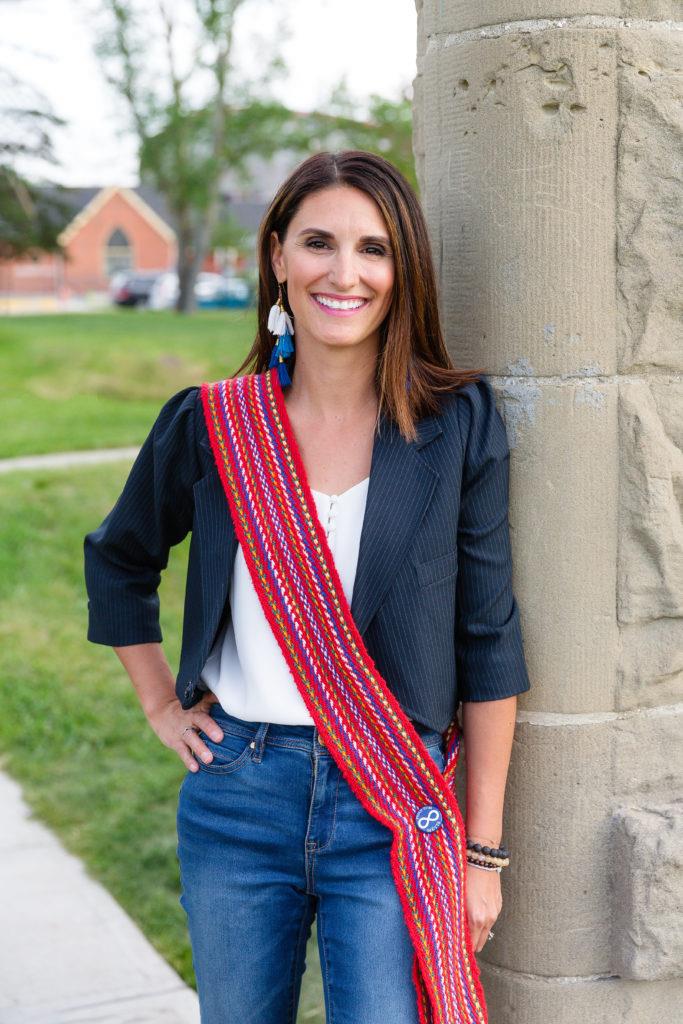
Our guest speaker at our January 12, 2022 meeting was Lorelei Higgins who spoke to us about the shared path of Truth and Reconciliation.
Lorelei has deep professional and personal experience on this topic. As a Métis Canadian, she comes by her peacebuilding roots naturally. Her Métis heritage can be traced from the Red River in Winnipeg, Manitoba where her great-grandfather came across to Canada from Kent, England, and met her great-grandmother – a Cree and Ojibwe community leader.
In 1998-99, Lorelei went on a youth exchange with Rotary to South Africa and two decades later was selected in 2019 as a Rotary Peace Fellow to attend the program at Chulalongkorn University in Thailand. For the past two years, she has also served as a Rotary Peace Activator with Mediators Beyond Borders and was the Co-Host of District 5040's 2021 District Conference.
In 2020, Lorelei was crowned Mrs. Globe Canada at a pageant sponsored by the Women In Need Foundation that was held in Las Vegas. She entered the competition with the goal of using the platform to speak about world peace - cleverly turning a cliché into a mandate. Her day job is the City of Calgary’s Community Land Community Mediator for the municipality’s anti-racism portfolio. In her combined roles with the City of Calgary, as Mrs. Globe Canada, and as a Rotary Peace Activator, she hosts community dialogue workshops and Indigenous relations training, helping people contribute to everyday peace-building initiatives in their communities.
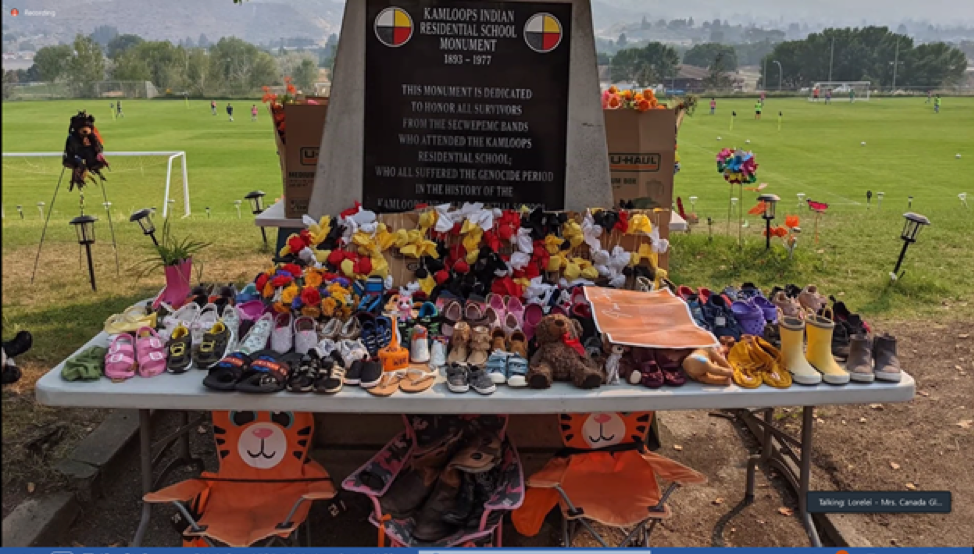
Lorelei spoke to us about her recent visit to the former Kamloops Indian Residential School to pay her respects following the discovery of probable graves on the site of the former institution. It was both a personal and a professional visit for her. Her mother grew up in Kamloops and, in addition to visiting family, she was promoting peace through elevating female voices and helping people contribute to everyday peace-building initiatives in their communities.
Lorelei shared some of the key findings and recommendations of the Truth and Reconciliation Commission, including that that the odds of dying for children in Indian residential schools was 1 in 25, compared to the 1 in 26 odds that faced Canadians serving in World War II.
In terms of what Rotarians can specifically do, Lorelei offered some advice, including:
As Rotarians who pride ourselves being "people of action, we need to slow down to go at the pace that we can as individuals and as clubs - "don't hurry towards reconciliation action because the relationship between Indigenous and non-Indigenous peoples has taken 500 years to get where we are now."
Be gentle and kind with the facts, stories and learnings as we internalize and digest - "listen and grapple with the it...taking the time to sit in the truth."
Key resources that Lorelei offered to help us build understanding and engagement include the following:
Lorelei's final message to us was that, "the shared path forward requires all of us." She offered several inspiring images to illustrate this principle, including: the traditional woven Two-Row Wampum Belt which embodied the original understanding of how European and Indigenous communities would co-exist in their own "lanes of governance" while collaborating on a shared path forward; and, the photo below of Indigenous and non-Indigenous children playing soccer together on the field behind the memorial of the former Kamloops Indian Residential School and the missing children.
Thank you to Lorelei for helping us to understand and embrace the challenge of stepping up to a meaningful commitment to Truth and Reconciliation in the months and years ahead.
A Peace Conversation About Reconciliation
Using what we learned from Thomas Reppchen’s presentation on life in East Germany and his escape and Lorelei Higgins’ presentation on Truth and Reconciliation, our January 19th meeting was dedicated to a Peace Conversation.
Our Peace Conversation was skillfully guided by the following five guest Rotarians who have all completed the Rotary-Mediators Beyond Borders International (MBBI) Peace Conversation training: Lead Facilitator, Drew Antrobus and four Facilitators, Ardeth Paxton Mann, Jane Blaiklock, John Anderson and Shirley-Pat Chamberlain.
The objective of the conversation was to provide responses to the following questions:
What did we learn from our two previous speakers at the Club (Thomas and Lorelei)?
As a Club, how can we work with our community re: the Truth and Reconciliation recommendations?
How can we improve our relationship with our local Indigenous Community (Musqueam, Squamish, Tsleil-Waututh)?
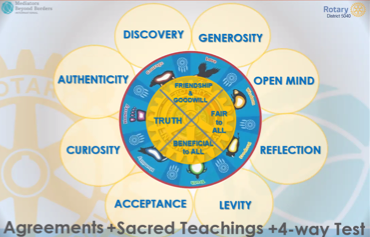
As an introduction to the Peace Conversation, Drew walked us through the guidelines for participation, specifically the MBBI Indigenous Sacred Teachings and the Rotary 4-way Test.
The participants then split into 5 groups, each with its own Facilitator. After discussing each of the three questions and loosely summarizing their results, the groups reunited to report back with their respective outcomes.
Although the detailed conclusions are too extensive to summarize here, the feedback from the groups was very positive, thoughtful and provided many good suggestions which we will explore as a club over the coming months in planning future service and engagement activities.
Many thanks to our Rotarian Facilitators for helping make this a successful Peace Conversation.
On January 26, 2022, we welcomed Dan Turnvill to our weekly meeting to speak to us about the work being done by the Strathcona Community Policing Centre and how our club can get involved.
Dan is the Executive Director of the Strathcona Community Policing Centre, which is one of 11 community policing centres across Vancouver, and is the major initiatives run by the Strathcona Community Safety Association, a registered charity. Dan joined the Strathcona Community Policing Centre in 2020, after a decade working in sports management with the BC Soccer Association, including 2 years as the head of Discipline.
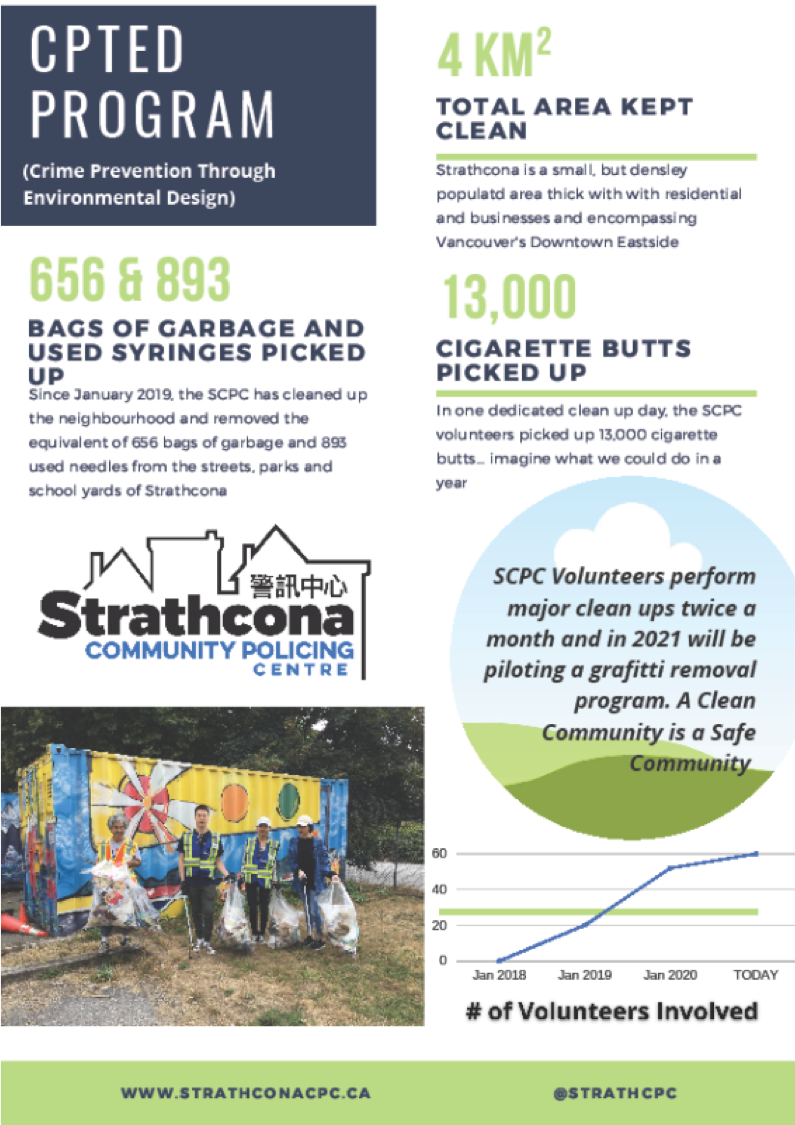
Since opening in 2017, the Strathcona Policing Centre now addresses an average of 1800+ in-person, and online/phone inquiries a year through its street front office at 872 East Hastings Street. The 100+ trained volunteers provide information and referrals for shelter and housing, legal assistance, and addiction counselling as well as a myriad of programs in the community. These include:
Crime prevention and personal safety workshops
Bike registration and theft prevention clinics as well as returning "found" stolen bikes to owners
Volunteer patrols by foot, bike and "pooch and paw" patrols with dogs who help increase engagement with local residents
Vehicle audits - over 22,000/year
Door-to-Door Crime Alerts - over 1200/year
Speed Watch, Distracted Driving and Pedestrian Safety Watches
Food drives and Warm Winter Wishes food and clothing handouts
Assistance with cultural events, block parties and other special events
Twice monthly community clean-ups of graffiti, garbage, syringes, and cigarette butts
Community art projects
Educational workshops such a "target hardening" where security experts assist with home and business building security; and
Restorative Justice sessions.
The Centre is actively seeking more volunteers, particularly anyone with fluency in other languages, unique skills (computer, artistic, martial arts or other certificates) or experience with or knowledge of the justice system and policing. Training is provided by the VPD and other professionals.
Dan invited us to consider volunteering with the Centre through two potential opportunities - either by signing up to be be a "Full Volunteer" who commits to a minimum of 6 hours/month or as a "Community Volunteer" who helps out with events such as (community clean ups.
We will be following up with Dan to seek out opportunities with the Strathcona Community Policing Centre for a club/team service project in the coming months. In the meantime, you can find out more here https://strathconacpc.ca
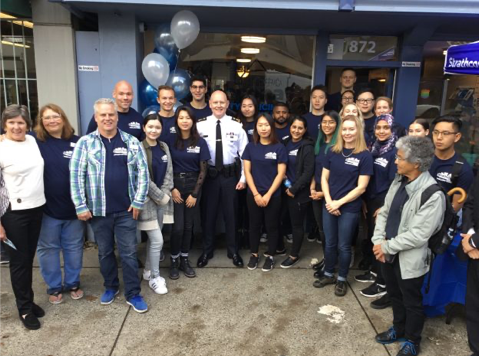
Strathcona Community Policing Centre Volunteers earlier this year, including our own Ron Suzuki.




.png)